
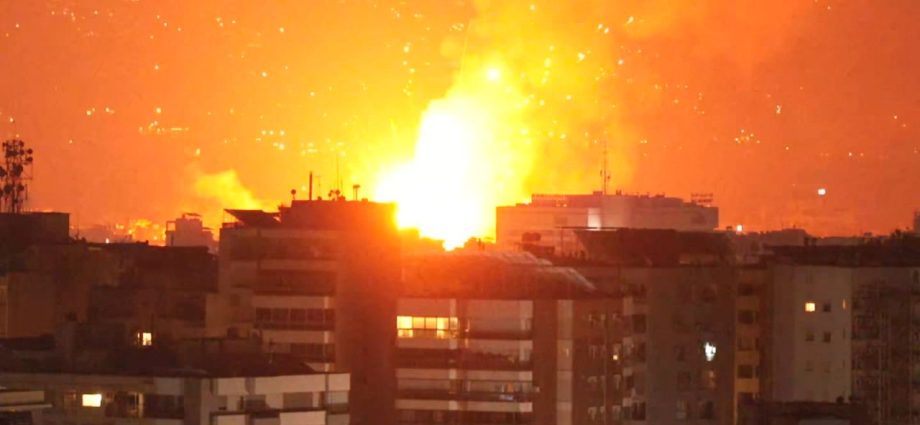
Huge flames in Tehran after Israeli strikes on oil refineries 
The Israeli military struck several Iranian fuel sites late on Saturday, sending huge balls of fire and smoke into the air.
WASHINGTON+TEHRAN ( Web News )
U.S. President Donald Trump said he is not interested in negotiating with Iran and raised the possibility that the Iran war would only end once Tehran no longer has a functioning military or any remaining leadership in power.
Speaking to reporters aboard Air Force One on Saturday, Trump said the air campaign could make negotiations a moot point if all potential leaders of Iran are killed and the Iranian military is destroyed.
“At some point, I don’t think there will be anybody left maybe to say ‘We surrender,'” Trump said.
Israel and Iran traded numerous attacks on Saturday as the U.S.-Israeli war against Iran entered a second week. Iran’s president apologized to neighboring states for its attacks on U.S. facilities in those countries, in an attempt to cool anger across the Gulf, but stirred criticism from hardliners at home.
Amid possible divisions within Iran’s leadership over Pezeshkian’s remarks, Israeli Prime Minister Benjamin Netanyahu, in a televised address, said any members of Iran’s Islamic Revolutionary Guard Corps who laid down their arms would be unharmed.
Ali Larijani, Iran’s secretary of the Supreme National Security Council, said on state television there was no rift among Iranian officials over its handling of the war.
In Oslo, the U.S. embassy was hit by an explosion early on Sunday, causing minor damage but no injuries, Norwegian police said. Smoke was seen rising from the area around the embassy compound, eyewitnesses told Norwegian daily Verdens Gang. It was not immediately clear what caused the blast or who was involved.
The U.S. State Department did not immediately respond to a request for comment.
Saudi Arabia has told Tehran that continued Iranian attacks on the kingdom and its energy sector could push Riyadh to respond in kind, four people familiar with the matter told Reuters.
Saudi Arabia foiled a drone attack on Riyadh’s diplomatic quarter, the Saudi defense ministry said early on Sunday. No injuries were reported.
Pezeshkian’s comments caused a political stir in Iran, prompting his office to reiterate Iran’s military would respond firmly to attacks from U.S. bases in the region.
Hours later, the president repeated his statement on social media but left out the apology from his speech that had angered hardliners, including the powerful Revolutionary Guards.
The judiciary chief, Mohseni-Ejei, a hardline member of the three-man council temporarily holding the powers of supreme leader, said the territory of some regional countries was being used for attacks against Iran and retaliatory strikes would continue.
Hours after Pezeshkian’s announcement, the Revolutionary Guards said their drones struck a U.S. air combat center near Abu Dhabi, capital of the United Arab Emirates. Reuters could not independently verify that report.
The Kuwaiti army said on Saturday that fuel storage tanks belonging to Kuwait International Airport were targeted in a drone attack.
In Iran, local news agencies, citing an Iranian Oil Ministry source, said its fuel depots were hit by strikes in three areas, including Karaj, west of Tehran.
The Revolutionary Guards also targeted U.S. forces at a base in Bahrain, Iranian state media said, and blasts were heard in Doha.
Tehran has responded to the U.S.-Israeli war on Iran by hitting Israel and Gulf Arab states hosting U.S. military installations. Israel has launched fresh attacks in Lebanon after the Iran-aligned militia Hezbollah fired across the border.
With the conflict spreading, Israel warned Lebanon of a “very heavy price” if it did not rein in Iran-allied Hezbollah militants, as it pounded the group’s strongholds with airstrikes and mounted a deadly airborne raid in the east.
On Saturday morning, more buildings in the Hezbollah-controlled southern suburbs of Beirut had been reduced to mounds of smoking rubble, dust and tangled wires, Reuters video showed.
The death toll from Israel’s attacks on Lebanon since Monday rose to around 300, after at least four people were killed when an Israeli strike hit an apartment in the Ramada hotel building in central Beirut, Lebanon’s health ministry said. It was the first strike to hit the heart of the capital since Israel-Hezbollah hostilities resumed last week.
The U.S.-Israeli attacks have killed at least 1,332 Iranian civilians and wounded thousands, according to Iran’s U.N. ambassador, Amir Saeid Iravani. Huge explosions were heard in parts of Tehran, state media reported, while Israel said it had struck Iranian missile sites and command centers.
Iranian attacks have killed 10 people in Israel. At least six U.S. service members have been killed. Their remains arrived on Saturday at an Air Force base in Delaware.
Iran’s apparent strategy of maximum chaos has driven up the costs of the conflict by raising energy prices and hurting global business and logistics links.
Kuwait’s national oil company began cutting output on Saturday, adding to earlier oil and gas cuts from Iraq and Qatar.
The war has roiled global markets and oil prices have hit multi-year highs with the Strait of Hormuz effectively shut.
Hardline clerics have called for the swift selection of a new supreme leader, Iranian media reported on Saturday, with meetings occurring as soon as Sunday.
The attacks, seen in videos circulating on social media and verified by The New York Times, appeared to be the first on Iran’s energy infrastructure since the United States and Israel launched strikes on Iran last weekend. Until this weekend, the U.S.-Israeli bombing campaign had been largely focused on ravaging Iran’s leadership and security services, and police stations, while also trying to eliminate its ability to produce and launch missiles and prevent Tehran from being able to produce nuclear weapons.
But Tehran is a sprawling metropolis of 10 million people, with densely packed neighborhoods, and as in many cities, residential, commercial and military structures are in proximity to one another. Iranian media and residents have reported widespread destruction to residential homes, shops, roads, water pipes and several hospitals and schools, located near targets sites.
Iran’s Ministry of Oil said in a statement that multiple oil storage depots in the provinces of Tehran and Alborz had been targeted.
The Israeli military confirmed in a statement that it struck several Iranian fuel sites late on Saturday, sending huge balls of fire and smoke into the air and rocking Tehran and the neighboring city of Karaj with explosions.