
ISLAMABAD ( WEB NEWS )
The concern was expressed in a joint statement issued on Friday by the foreign ministers of Pakistan, Egypt, Indonesia, Jordan, Qatar, Saudi Arabia, Türkiye and the United Arab Emirates. The ministers said heavy rainfall and storms have compounded an already fragile humanitarian environment, particularly for displaced families living in makeshift shelters.
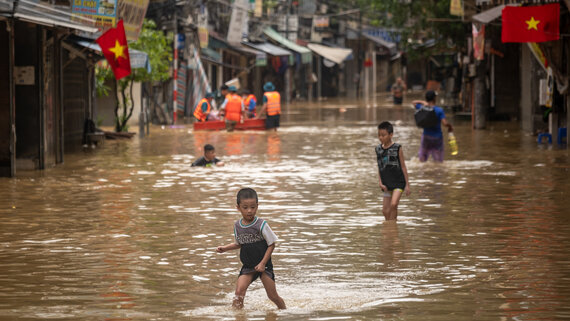
On 7 September 2024, Super Typhoon Yagi, the strongest storm in Viet Nam in 70 years, made landfall, affecting 14 northern provinces and impacting the lives of millions of children and families. The affected regions, including Quang Ninh, Bac Giang, and Lang Son, have experienced severe flooding, landslides, and infrastructure damage, with wind speeds surpassing 220 km/h and relentless rainfall exceeding 400 mm in many areas.
Preliminary data from the Government of Viet Nam reports that at least 350 people have died or are still missing, and more than 250 have been injured. Health facilities, water infrastructure, and schools have sustained severe damage, while 3 million people lack access to safe drinking water and 2.4 million school children are at risk of disrupted education. Over 3,000 homes have been destroyed, and 272,000 hectares of farmland severely affected, pushing millions of families into further vulnerability.
In response, UNICEF, in coordination with the Government of Viet Nam and humanitarian partners, is leading emergency relief efforts. The focus is on delivering life-saving water, sanitation, and hygiene (WASH) supplies, and health and nutrition interventions, as well as ensuring the protection and education of children. Humanitarian cash transfers are also being provided to help the most affected families recover.
As part of the initial response, UNICEF has already distributed water purification tablets, storage tanks, and hygiene supplies, while rapidly mobilizing additional resources. At least US$ 15 million is required for UNICEF’s multisectoral response to meet the urgent needs of affected children and families and to support early recovery.
This folder contains visual and a
According to the joint statement, harsh and unstable weather has exacerbated flooding in displacement camps, damaged tents and caused the collapse of already weakened structures. The ministers highlighted that nearly 1.9 million people, many of them displaced, are living in inadequate shelters and exposed to cold temperatures. Malnutrition, coupled with exposure and overcrowding, has significantly heightened the risk of disease outbreaks, especially among children, women, the elderly and people with medical vulnerabilities.
The situation has been further aggravated by acute shortages of life-saving supplies and the slow pace of entry of materials needed to restore basic services and establish temporary housing. The ministers noted that insufficient humanitarian access continues to undermine efforts to stabilise conditions on the ground.
The foreign ministers commended the efforts of United Nations organisations, particularly the UN agency for Palestinian refugees UNRWA, as well as international humanitarian NGOs, for continuing to assist civilians under extremely difficult circumstances. They demanded that Israel ensure the UN and humanitarian agencies are able to operate in Gaza and the West Bank in a sustained, predictable and unrestricted manner, stressing that any attempt to impede their work is unacceptable.
They also called for the immediate lifting of constraints on the entry and distribution of essential supplies, including tents, shelter materials, medical assistance, clean water, fuel and sanitation support, urging the international community to uphold its legal and moral responsibilities.
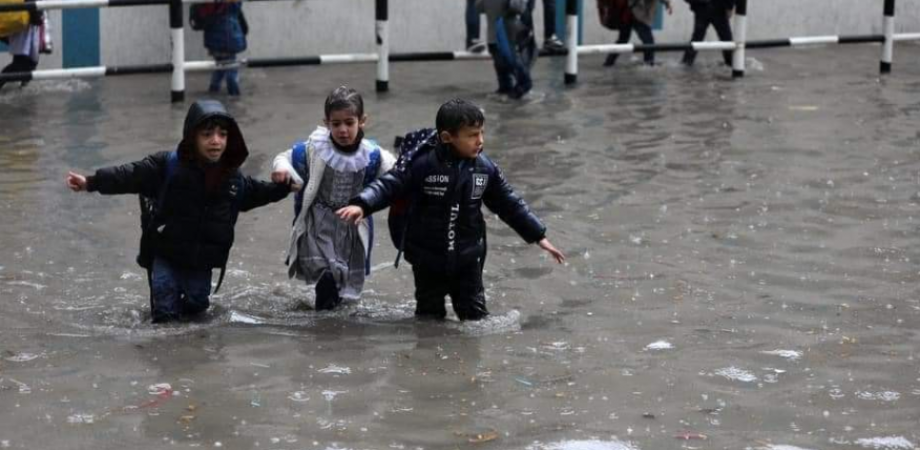
The ministers reaffirmed their full support for United Nations Security Council Resolution 2803 and President Donald Trump’s Comprehensive Plan, adopted by the Security Council in November last year, which underpins ongoing ceasefire efforts. They expressed their intention to contribute to its successful implementation to ensure the sustainability of the ceasefire, bring an end to the war in Gaza and secure a dignified life for the Palestinian people, alongside a credible pathway to self-determination and statehood.
In this context, they stressed the urgent need to initiate and scale up early recovery efforts, including the provision of durable and dignified shelter to protect civilians from severe winter conditions. The statement also called for immediate, full and unhindered humanitarian aid into Gaza through the UN and its agencies, the rehabilitation of infrastructure and hospitals, and the opening of the Rafah Crossing in both directions, as stipulated in the plan.