
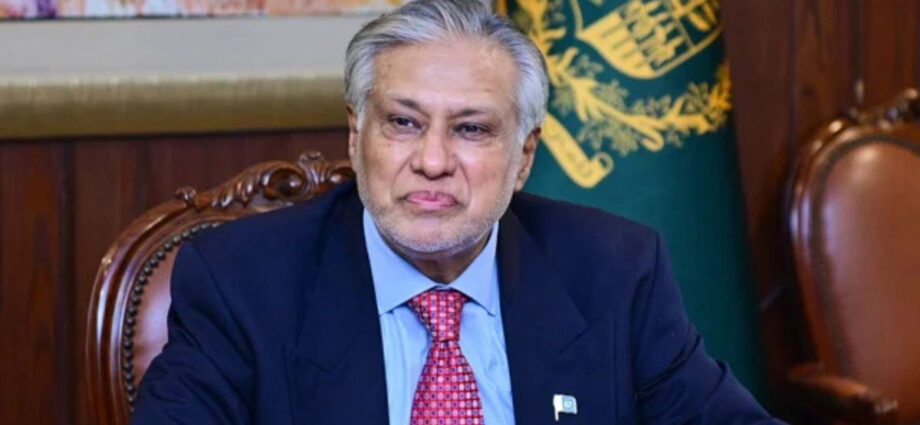
India committed a super mistake while attacking the Noor Khan Airbase: Ishaq Dar
Ishaq Dar also affirmed that Pakistan will not take steps to disarm Hamas, clarifying the country’s position amid rising tensions over Palestine.
Says during the four-day long war, Pakistani armed force crushed the Indian pride & claims
Says lasting peace in South Asia impossible without resolving the J&K dispute
Says we now have to make Pakistan an economic power
ISLAMABAD ( WEB NEWS )
Recalling military victory against India in May this year, Deputy Prime Minister/Foreign Minister Senator Mohammad Ishaq Dar on Saturday said that Pakistan must now be transformed into an economic power, stressing that the government is pursuing a coordinated strategy to achieve stability and growth. He said that India committed a super mistake while attacking the Noor Khan Airbase. He said that during the four-day long war, Pakistani armed force crushed the Indian pride and claims.
“We now have to make Pakistan an economic power,” said Ishaq Dar while addressing a yearly news conference at the Foreign Office in Islamabad. Ishaq Dar said Pakistan’s foreign policy stature had improved globally and the country’s position was being heard and acknowledged at international forums.
Ishaq Dar also credited Prime Minister Mian Muhammad Shehbaz Sharif for efforts aimed at strengthening the economy, saying the government was working to ensure long-term financial stability.
“Prime Minister Shehbaz Sharif is making continuous efforts to stabilise the country economically,” he said. Ishaq Dar welcomed the visit of the UAE President to Pakistan, saying, “The UAE president had promised the prime minister a visit to Pakistan this year, and his visit is a positive development.” He said discussions during the visit focused on “bilateral trade, investment and the energy sector.”
He went onto say that Saudi Arabia had supported Pakistan in securing the International Monetary Fund programme, adding, China has deposited $4 billion in Pakistan, while the UAE has placed $3 billion.
Referring to tensions with India, Ishaq Dar said Pakistan had shot down Indian aircraft during recent hostilities. “We shot down seven Indian aircraft during the war,” he said, adding that “Pakistan did not ask anyone for a ceasefire.”
During the four-day war, Ishaq Dar said, India sent 80 drones over a 36-hour period; Pakistan shot down 79 of them, while one drone managed to strike a military installation, injuring one person.
He added that the United States secretary of state contacted him directly following Pakistan’s befitting response to Indian aggression.
Ishaq Dar said that Pakistan must now concentrate on becoming an economic power, noting that trade with the US had reached $13.28 billion and was currently in surplus.
Ishaq Dar said Washington had designated the BLA and Majid Brigade as global terrorist organisations this year, while counterterrorism cooperation between the two countries had also increased.
On regional issues, Ishaq Dar reiterated that lasting peace in South Asia was impossible without resolving the Jammu and Kashmir dispute and condemned India’s demographic changes in the Indian Illegally Occupied Jammu and Kashmir (IIOJK). He said resolution of the dispute as per the aspirations of Kashmiri people and relevant UN resolutions is inevitable for durable peace in South Asia.
He said that Islamabad would engage Bangladesh in talks following the latter’s general elections scheduled to be held in February next year.
Pakistan’s diplomatic outreach had widened, he said, highlighting renewed engagement with the European Union through a strategic dialogue in Brussels after a four-year hiatus and close coordination with China.
Highlighting ties with Beijing, Ishaq Dar said Pakistan’s relations with China were “ideal” and described the country as a highly reliable partner.
He recalled that Chinese Foreign Minister Wang Yi visited Pakistan in August, during which a trilateral meeting was first held in Kabul. Ishaq Dar also noted that President Asif Ali Zardari had visited China multiple times in the past and continued to show interest in another visit.
Turning to the Middle East, Ishaq Dar highlighted the strategic mutual defence agreement signed with Saudi Arabia on September 17, covering cooperation in defence, energy, technology and mining, adding that ties with Turkiye, Iran, Gulf states and Central Asian countries remained strong.
He added that contacts with Iran had increased and that Pakistan had condemned the attack on Iran on June 13.
He further said Pakistan enjoyed close ties with Bahrain, Iraq, Kuwait and Qatar, reflecting what he described as a broad-based and balanced foreign policy approach.
At the same briefing, Ishaq Dar also affirmed that Pakistan will not take steps to disarm Hamas, clarifying the country’s position amid rising tensions over Palestine.
Ishaq Dar said that the civil and military leadership were fully aligned on not sending troops to Gaza for the purpose of disarming Hamas.
Ishaq Dar condemned Israel’s continued violations of the peace deal, which have resulted in the killing of hundreds of Palestinians, including women and children. “Israel is still breaching the agreement, and we are condemning it,” added.
Ishaq Dar noted that the eight Muslim countries, including five Arab states, have decided to work with the US for peace in Palestine.
Pointing out the uniformity of statements, he noted that all eight foreign ministers issued the same statement on developments regarding peace in Palestine.
Ishaq Dar said the outgoing year 2025 remained a year of remarkable achievements for Pakistan at diplomatic and foreign policy fronts. He said this year is marked by a victory of Pakistan’s narrative in the international arena.
Ishaq Dar said Pakistan rose to new heights of global eminence and recognition during this year.