


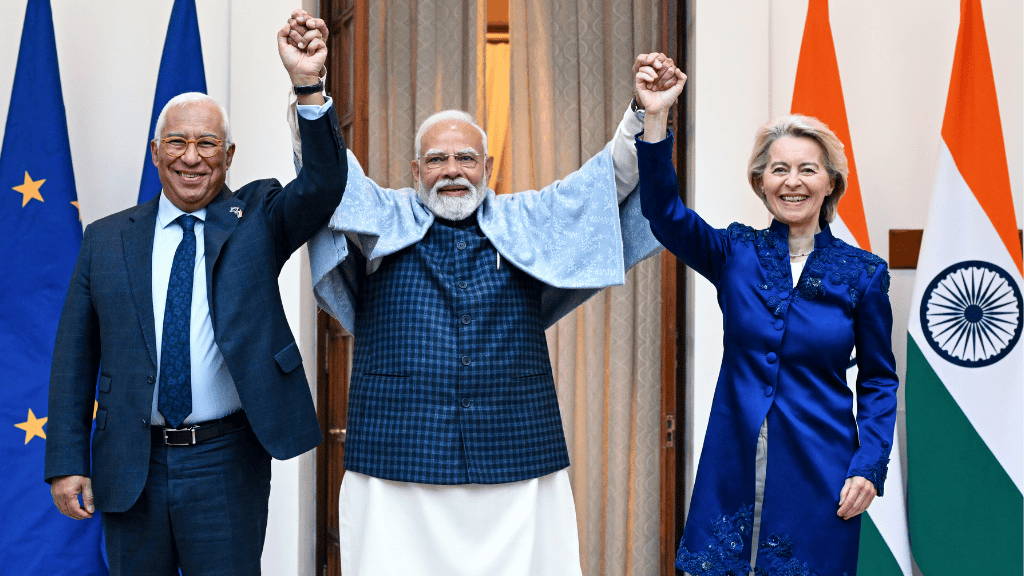
EU–India partnership whitewashes India’s authoritarian slide and escalating human rights catastrophe: Muzzammil Ayyub Thakur
Says the genuine democracy demands equal protection & justice for all citizens
LONDON ( Web News )
Executive Director, the Kashmir Centre, President, WKFM, Dr. Muzzammil Ayyub Thakur has said that European Commission President Ursula von der Leyen’s recent portrayal of India as “the world’s largest democracy” and a pillar of “global stability, prosperity, and security”, coupled with her framing of the EU–India Security and Defence Partnership as a union between “the world’s two largest democracies”, is not merely optimistic rhetoric. It is a dangerous distortion that actively shields a regime engaged in systematic democratic backsliding, minority persecution, and state-sponsored transnational violence from international scrutiny.
Muzzammil Ayyub Thakur in a statement issued on Wednesday said that this uncritical endorsement directly contradicts the European Union’s foundational commitments to democracy, human rights, and the rule of law. By glossing over India’s well-documented descent into authoritarian practices, the EU risks complicity in normalizing repression and eroding its own moral authority, particularly when contrasted with its firm stance against similar violations by Russia in Ukraine.
He said that a vibrant democracy requires a free and fearless press. India’s reality is the opposite. In the 2025 World Press Freedom Index by Reporters Without Borders (RSF), India ranks a dismal 151st out of 180 countries, an improvement from 159th in prior years, but still firmly in the “very serious” crisis category, where journalism is perilous and independent reporting is systematically suppressed.
Muzzammil Ayyub Thakur said that journalists investigating minority rights abuses, government corruption, protests, or the situation in Kashmir face relentless harassment: arbitrary arrests under draconian counter-terrorism and sedition laws, midnight raids on media offices, prolonged internet blackouts, and physical intimidation. The concentration of media ownership in the hands of pro-government oligarchs further strangles pluralism, turning much of the mainstream press into a mouthpiece for the ruling Bharatiya Janata Party (BJP).
Muzzammil Ayyub Thakur said that the independent civil society faces existential threats. The misuse of foreign funding laws (FCRA) has become a weapon to bankrupt and dismantle human rights organizations. The forced closure of Amnesty International’s operations in India remains a chilling emblem of how regulatory pretexts are deployed to eliminate scrutiny rather than promote transparency. Hundreds of NGOs have been deregistered or crippled, creating a vacuum where state abuses go unchallenged.
He said that the genuine democracy demands equal protection and justice for all citizens. Yet India under the current government has presided over a surge in targeted persecution of religious minorities, primarily Muslims, but also Christians, Sikhs, and others.
Muzzammil Ayyub Thakur said that Human Rights Watch’s World Report 2025 documents widespread failures to protect minorities, including vigilante violence emboldened by anti-conversion laws in at least 12 states, “bulldozer justice” demolitions of Muslim homes as collective punishment, and mob attacks on prayer gatherings. Anti-minority hate speech rose 13% in 2025, with the vast majority occurring in BJP-governed states, according to a Washington-based research group. Prime Minister Modi’s own campaign rhetoric has repeatedly fuelled hostility and incitement against Muslims.
He said that impunity reigns: perpetrators of communal violence face little accountability, while victims encounter barriers to justice and further state harassment.
Muzzammil Ayyub Thakur said that India holds large-scale elections, but democracy is far more than periodic voting. International assessments paint a grim picture: Freedom House and V-Dem reports highlight India’s continued decline in liberal democracy rankings (e.g., V-Dem placing it at 100th out of 179 in recent indices), driven by executive overreach, judicial erosion, prolonged pre-trial detentions of critics, curbs on peaceful assembly, and the weaponization of national security laws against dissenters.
He said that the 2019 revocation of Jammu and Kashmir’s special status unleashed a template of militarized control now exported across India. Prolonged lockdowns, mass arbitrary detentions, internet shutdowns, and heavy securitization violate international human rights standards. Kashmir has long served as a testing ground for repressive tactics, custodial torture, enforced disappearances, staged encounters, that increasingly appear in mainland India.
Muzzammil Ayyub Thakur said that worse, India’s repression extends beyond borders. Credible allegations link Indian agents to transnational assassinations and plots, including the 2023 killing of Canadian Sikh activist Hardeep Singh Nijjar, a foiled assassination attempt in New York against another Sikh leader, attacks on Kashmiri activists in London, and reports of over two dozen targeted killings of Kashmiris in Pakistan. These acts represent a brazen violation of sovereignty and international norms, yet receive little rebuke from partners like the EU.
He said that the strategic cooperation cannot come at the expense of human rights. By parroting India’s self-congratulatory narrative without confronting these escalating violations, the EU undermines its credibility and signals that geopolitical expediency trumps universal values.
He said that a genuine EU–India partnership must incorporate binding mechanisms for human rights monitoring, transparent dialogue on democratic erosion, and consequences for persistent abuses. Rhetoric alone will not suffice; consistency, accountability, and the willingness to name uncomfortable truths are essential.
Muzzammil Ayyub Thakur said that the EU must adopt more precise, principled language and a more evolved approach toward India, one that prioritizes human dignity over strategic convenience.