


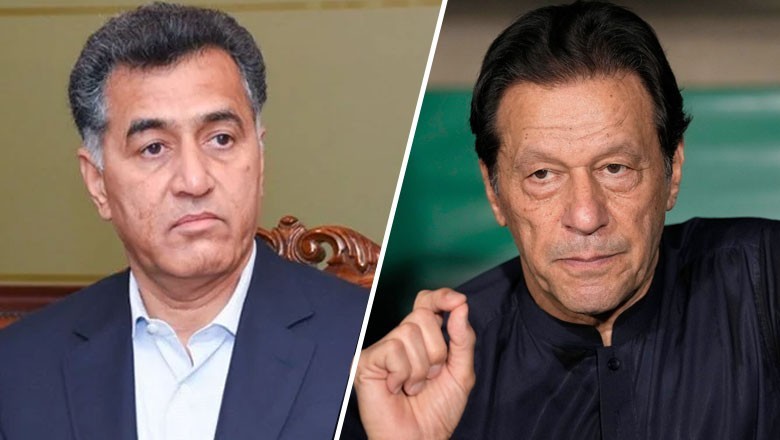
Ex-DG ISI was used by PTI founder for politics: DG ISPR
The DG ISPR criticised continued calls by KP govt for negotiations with terrorists, questioning their motivations.
The ISPR chief also alleged that India was providing financial and logistical support to militant groups operating against Pakistan
RAWALPINDI ( WEB NEWS )
Director General Inter-Services Public Relations (DG ISPR) Lt Gen Ahmed Sharif Chaudhry said on Tuesday that former DG ISI Faiz Hameed was used by the Pakistan Tehreek-e-Insaf (PTI) founder and former prime minister Imran Khan for political purposes.
Addressing a press conference, the DG ISPR reiterated that terrorism remains the biggest threat facing the state of Pakistan, adding that counter-terrorism operations in 2025 witnessed unprecedented intensity.
Responding to a question regarding the resettlement of terrorists in 2021 and allegations of selective accountability, the DG ISPR said that institutions lose effectiveness and independence when politicised. He stressed that the armed forces are the only institution that remains above politics.
Without naming Imran Khan directly, Lt Gen Ahmed Sharif Chaudhry said that at the time, the then prime minister runs his political party in a dictatorial manner, with the entire party and government revolving around a single individual.
“This was not an institutional matter; it was a game of personalities,” he said, adding that institutions should not be blamed for decisions taken for personal political interests.
“Where is the DG ISI from that time who was used for political purposes?”, DG ISPR questioned.


DG ISPR said that the former prime minister was extremely powerful, contradicting the claims that he lacked authority.
“He was so powerful that he declared the then Army Chief as the ‘father of the nation’. No prime minister since 1947 has ever exercised such authority,” he said.
He added that Pakistan has only one founding father — Quaid-e-Azam Muhammad Ali Jinnah, and one national poet, Allama Muhammad Iqbal, rejecting what he described as attempts to reshape national symbols for political convenience.
The DG ISPR criticised continued calls by KP govt for negotiations with terrorists, questioning their motivations.
“They have already pushed their own province into this fire and now want to drag the entire country into it,” he said, adding that such approaches have only worsened the security situation.
Pakistani military spokesman has said that Afghan militants were involved in major terrorist incidents in the country during 2025, as he described the past year as a “landmark and consequential year” in the country’s fight against terrorism.
Addressing a detailed press conference on Tuesday, Inter-Services Public Relations (ISPR) Director General Lieutenant General Ahmed Sharif Chaudhry said the sole purpose of the briefing was to present a comprehensive overview of counterterrorism measures taken over the previous year, stressing that terrorism remained the biggest threat faced by the Pakistani state.
Lt-Gen Chaudhry said 2025 marked a turning point for four key reasons, including unprecedented intensity in counterterrorism operations, nationwide clarity on the nature of terrorism, international acknowledgement of Pakistan’s stance that Afghanistan had become a base for terrorist activity, and the reinvigoration of the National Action Plan (NAP).
He said the fight against terrorism had been ongoing for more than two decades and involved the entire nation, but last year stood out due to the scale and consistency of operations. According to official data shared during the briefing, law enforcement agencies carried out 75,175 intelligence-based operations across the country in 2025, averaging 206 operations per day.
Of these, 14,658 operations were conducted in Khyber Pakhtunkhwa, 58,778 in Balochistan and 1,739 in other parts of Pakistan. Despite this operational intensity, 5,397 terrorist incidents were reported nationwide during the year. Khyber Pakhtunkhwa accounted for 3,811 incidents, or 71 per cent, while Balochistan reported 1,557 incidents, with 29 incidents recorded elsewhere.
The DG ISPR said 2,597 terrorists were killed during counterterrorism operations in 2025, including 1,800 in Khyber Pakhtunkhwa, 784 in Balochistan and 10 in other areas. During the same period, 1,235 law enforcement personnel and civilians were martyred.
He also shared figures related to suicide attacks, stating that 27 suicide bombings took place in 2025. Sixteen occurred in Khyber Pakhtunkhwa, ten in Balochistan and one at Islamabad’s judicial complex. Two of these attacks involved female suicide bombers.
While explaining why Khyber Pakhtunkhwa remained the most affected province, the ISPR chief blamed what he termed a “politically conducive environment” and a flourishing political-criminal-terror nexus. He said this environment had enabled terrorist groups to operate and expand their influence in the province.
Providing historical context, Lt-Gen Ahmed Sharif Chaudhry said terrorism began rising sharply from 2021. That year, 193 terrorists were killed while 592 law enforcement personnel were martyred, reflecting a ratio of one terrorist killed for every three personnel lost. By 2025, he said, this ratio had shifted to roughly two terrorists killed for every one member of the security forces, with 2,597 militants eliminated and 1,235 personnel martyred.
He linked the resurgence of terrorism to developments in Afghanistan following the 2020 Doha Agreement between the United States and the Afghan Taliban. Under the agreement, the Afghan Taliban had committed to forming an inclusive government, preventing the use of Afghan soil for terrorism and ensuring rights for women. He said none of these commitments had been fulfilled, arguing that Afghanistan had instead become a hub for terrorist organisations and non-state actors.
According to the ISPR chief, multiple terrorist outfits were operating from Afghan territory, turning the country into what he described as a centre for militancy. He said around 2,500 foreign terrorists, neither Afghan nor Pakistani, had recently entered Afghanistan from Syria.
He further alleged that the Afghan Taliban were reorganising and supporting the banned Tehreek-i-Taliban Pakistan, referred to by the state as Fitna al-Khawarij, by providing training, direction and operational space. He said Afghanistan-based groups linked to Balochistan, designated as Fitna al-Hindustan, were also operating with external backing.
Lt Gen Chaudhry said modern US military equipment worth approximately $7.2 billion was left behind in Afghanistan after the withdrawal of international forces, including night-vision devices, long-range sniper rifles, M-4 and M-16 rifles and protective gear. He said this equipment had entered black markets and was accessible to terrorist organisations.
The ISPR chief also alleged that India was providing financial and logistical support to militant groups operating against Pakistan, saying that Afghan territory was being used as a base while external patronage sustained what he described as a regional “war economy”.
Highlighting specific attacks, he said Afghan militants were involved in ten major terrorist incidents during 2025, all of which deliberately targeted civilians and soft targets. He cited the Jaffar Express attack, in which 21 civilians were martyred, as well as attacks on a civilian bus in Noshki and the Frontier Corps headquarters in Quetta, where eight civilians lost their lives. He said Afghan attackers were also behind a similar assault on the FC headquarters in Peshawar and an attempted attack on Cadet College Wana that sought to replicate the 2014 APS Peshawar massacre.
During the briefing, video confessions of arrested terrorists were shown, which Lt Gen Chaudhry said demonstrated clear evidence of where militants operated and how attacks were planned. He rejected claims that the Pakistan Army used drones for strikes against civilians, clarifying that drones were primarily used for surveillance, while accusing militant groups of using armed quadcopters with external support.
He said Pakistan had taken firm action along the Afghan border in recent months, including targeting militant infrastructure in October 2025 and eliminating dozens of hostile posts within hours, stressing that operations were directed against the TTP and not the Afghan Taliban as a whole.